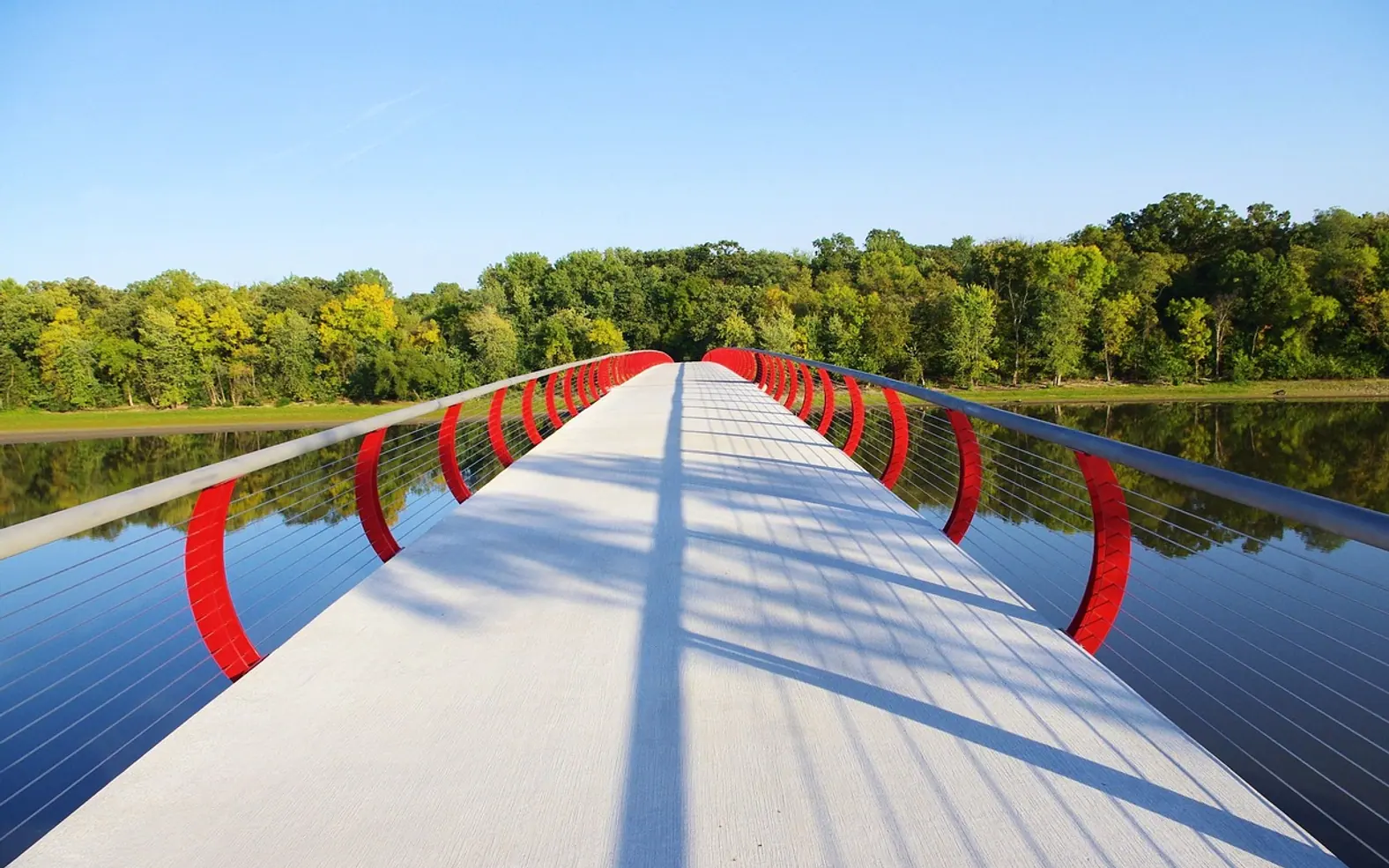
What Is a Rail Trail? Old Railway Lines Turned Into Paths
- Set off
- Length
- 4 min read
- Number
- 40
A rail trail is a public path laid on the route of a former railway line. Once the trains stop, the rails and ties are lifted and the corridor is resurfaced for walking and cycling and, depending on the trail, horse riding, running or cross-country skiing. Because railways were engineered for heavy trains, rail trails are long, gentle and largely free of steep climbs, which makes them some of the most relaxed places to ride a bike.
Why rail trails feel so easy
Locomotives struggle on steep hills, so railway builders cut through ridges, raised embankments across valleys and built bridges and tunnels to keep slopes slight. A trail on that alignment inherits the same profile. You can climb steadily for an afternoon without needing your lowest gear, and the return trip feels like one long freewheel.
The old infrastructure is often the highlight: viaducts, tunnels, deep cuttings, restored depots and mileposts that tell the story of the line.
Rails to trails: how a line becomes a path
Turning abandoned corridors into trails, often called the rails-to-trails movement, gathered pace as many rural branch lines closed. Local governments, park agencies and nonprofit groups typically buy or lease the corridor, remove the track, repair the drainage and lay a new surface.
In the United States, some corridors are railbanked: the trail occupies the route while it is held in reserve for possible future rail service. For people on the path this changes nothing day to day; it simply keeps the long corridor in one piece instead of letting it be sold off in fragments.
Common surfaces
| Surface | How it rides | Good bike choice |
|---|---|---|
| Asphalt or concrete | Smooth and quick, fine in wet weather | Any bike, including road bikes; also good for skates |
| Crushed stone | Firm when dry, softer after rain | Hybrid, gravel or mountain bike with wider tires |
| Natural or old ballast | Loose, bumpy, sometimes muddy | Mountain bike or wide-tire gravel bike |
Many trails mix surfaces, paved near towns and crushed stone through the countryside, so read the trail description before choosing tires.
Who uses rail trails
- Families learning to ride together away from traffic
- Commuters, where a trail links neighborhoods with a town center
- Walkers and runners after long, level routes
- Cycle tourists linking towns over several days
- Wheelchair users and parents with strollers on smoother, accessible sections
Trail etiquette
- Keep to the right and pass on the left, or follow the local convention where it differs.
- Ring a bell or call out clearly before passing.
- Yield to walkers, and everyone yields to horses. Slow right down and speak to the rider before going by.
- Match your speed to the crowd, especially near trailheads and on bridges.
- Pull to the side to stop, never in the middle of the path.
- Keep dogs on a short leash and clean up after them.
Planning a day or a weekend
Start from a trailhead with parking and restrooms, and look for towns along the way for food and water. Distances are usually marked, so it is easy to pick a turnaround point in advance. On longer trails, shuttle services sometimes carry riders or luggage between towns, letting you ride in one direction only.
Before you go, set your saddle at the right height, as described in our guide on adjusting your bike seat height; long level miles expose a poor position quickly. Wear a helmet that fits properly (see how to choose a bike helmet) and bring water, a spare tube and lights. Some tunnels are long and unlit, and noticeably cooler than the air outside.
Rail trails also make an ideal setting for a first night out with gear on the bike; our guide to bike camping for beginners covers what to pack.
Well-known examples
Rail trails exist on several continents. In the United States, the Katy Trail crosses much of Missouri on the former Missouri–Kansas–Texas railroad corridor, and the Great Allegheny Passage links Pittsburgh with Cumberland, Maryland. New Zealand's Otago Central Rail Trail follows the same idea, as do many former lines in Britain, Ireland, Canada and Australia. Local park agencies and visitor centers can point you to rail trails near you.
Questions about rail trails
Are rail trails good for beginners?
They are among the best places to start: gradients are gentle and there is no motor traffic apart from road crossings, where you should stop and look both ways.
Can I ride an e-bike on a rail trail?
Rules vary by trail and by e-bike class. Check the signs at the trailhead or the managing agency's rules before you ride.
Do I need a special bike?
No. A hybrid, or any bike with tires suited to the surface, works well.
Keeping lists useful
How to make a checklist you will actually use
A list only helps if it is short enough to read and close enough to grab.
Keep it near the job
Tape the ride check inside the garage door and the movie list beside the remote.
Fewer lines
If a list runs past a dozen items, split it into two smaller ones.
Verbs first
Start each line with an action, such as squeeze, test or pack, so it reads as a task.
Review each season
Lights matter more in winter and sunscreen more in summer, so update the list when the clocks change.
Topic by topic
Lifestyle
- IVG Pro Pods: A Close Look at Flavor Accuracy, Convenience, and Everyday Reliability
- Smart, Clean, On Schedule: Container Service That Helps Small Businesses Thrive
- Choosing The Right Photo Booth Hire For Weddings, Birthdays, And Corporate Events
- Thoughtful Gifting: Etiquette and Cultural Notes for Ordering from an Online Flower Delivery Shop